

An aromatherapy diffuser disperses fragrance into a room, but models can work in different ways and may have different requirements for water, oils, power and care. The right choice depends on how you want to use it and what you are comfortable maintaining.
This guide compares the main types and the checks that can help you choose a diffuser that fits your space and routine. It focuses on product characteristics rather than making claims about health or wellbeing effects.
Compare Aromatherapy Diffusers


As an Amazon Associate we earn from qualifying purchases.
Which aromatherapy diffuser should you choose?
Start by deciding whether you want a water-based electric diffuser, a model that disperses oil without water, or a simpler evaporative or heat-based option. Then check the product’s oil compatibility, intended room suitability, power requirements and care instructions. More features may offer extra convenience, but can also mean more components or maintenance. The best fit is the one whose use and upkeep match your preferences.
Compare the key buying factors
| Feature | What it means | Why it matters | What to check |
|---|---|---|---|
| Diffusing method | The way the device disperses fragrance, such as water-based mist, airflow, heat or oil atomisation. | Different methods have different setup and care requirements. | How it works and whether it requires water, a pad or another consumable. |
| Oil compatibility | Which oils or fragrance products the manufacturer says can be used. | Not every diffuser is intended for every type of oil or fragrance. | Product guidance and any restrictions for the oils you plan to use. |
| Room suitability | The space the manufacturer says the diffuser is intended for. | A device’s stated suitability can help you judge whether it fits the room where you plan to use it. | Any room-size guidance and whether it suits your intended placement. |
| Power and controls | How the diffuser is powered and what controls it offers. | Power access and preferred controls affect where and how conveniently you can use it. | Power source, cable or charging details, and any timer or lighting functions if listed. |
| Cleaning and upkeep | The care required for the reservoir, diffuser parts or scent pad. | Maintenance varies by design and can affect how much ongoing attention it needs. | Manufacturer cleaning instructions and whether pads or other consumables are required. |
| Size and placement | The device’s dimensions, shape and recommended position. | It needs a suitable place with appropriate access to power, if required. | Dimensions, stability guidance and any placement restrictions stated by the manufacturer. |
Decision criteria: what to look for
Choose a diffusing method that suits your routine
A water-based diffuser may suit someone who is happy to fill and care for a reservoir. A waterless model avoids that step, while evaporative and heat-based designs use different approaches to dispersing fragrance. Consider the setup and care each method involves, not just its appearance.
Check oil and fragrance compatibility
Check that the diffuser is intended for the specific type of oil or fragrance you plan to use. Some designs rely on a reservoir, while others may use a pad or a different arrangement. Do not assume a product is compatible simply because it is described as an aromatherapy diffuser.
Match the device to its intended space
Look for the manufacturer’s room-suitability guidance and compare it with where you plan to place the diffuser. Also consider its dimensions, access to a power source if needed, and whether the controls are practical for that location. Avoid treating a general description as a guarantee of how fragrance will be perceived in every room.
Consider power, controls and sound
Check whether the diffuser uses mains power, a rechargeable supply or another arrangement, and make sure that suits your intended location. Timers, lighting and other controls are model-dependent rather than essential features. If sound level matters in your chosen space, look for information about it on the individual product page.
Account for upkeep and ongoing supplies
Care can differ between water reservoirs, oil-contact parts and evaporative pads. Check the manufacturer’s cleaning guidance and whether the design needs any replaceable consumables. Specifications vary by model, so always check the individual product page before buying.
Common diffuser types
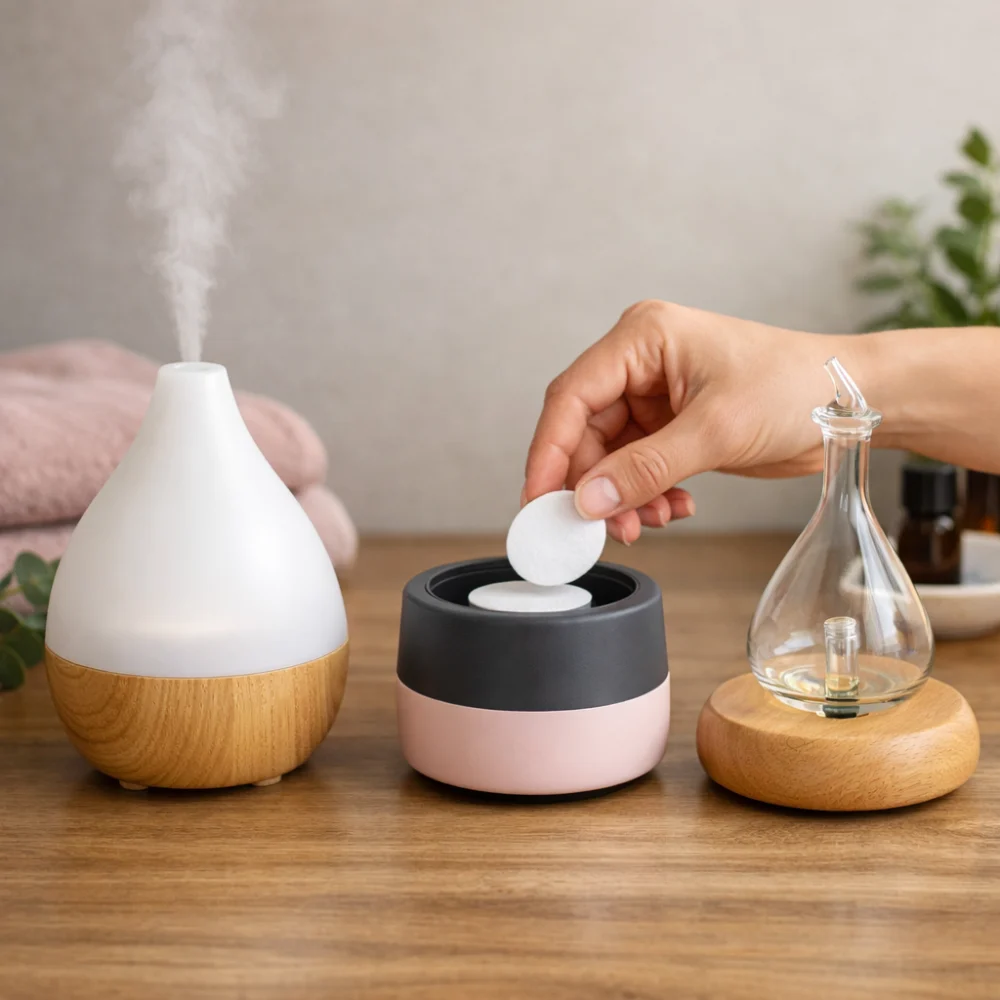
These types describe common ways of dispersing fragrance; names and designs can vary between products. Check the product information to confirm how a particular model works.
Water-based ultrasonic
These models use water and vibration to disperse a fine mist. They may suit buyers who prefer this style of diffuser and are comfortable caring for a reservoir. The need to manage water and clean the unit is a practical trade-off.
Nebulising
Nebulising designs use airflow to disperse oil without adding water. They may suit buyers looking for a waterless format, but check which oils the model accepts and what its upkeep involves.
Evaporative
Evaporative designs allow fragrance to disperse from a pad or another absorbent material, sometimes with airflow. They can be a straightforward option, though the pad or other component may need attention or replacement according to the product guidance.
Heat-based
Heat-based diffusers use warmth to disperse fragrance. Check that the product is intended for the oil or fragrance you want to use, and review any specific care and placement guidance before deciding.
Suitability by need
- For a low-maintenance preference: Compare how often the design needs filling, cleaning or pad changes. A simpler method may reduce some tasks, but check what care it still requires.
- For a waterless format: Look at nebulising or other products described as waterless, then confirm oil compatibility and the manufacturer’s care guidance.
- For a particular room: Use the manufacturer’s room-suitability information alongside the diffuser’s size, power needs and intended placement.
- For flexible controls: Compare timers, lighting and control options only if you will use them; extra functions can add complexity without being necessary for everyone.
- For a gift: Consider whether the recipient already has suitable oils, whether the diffuser requires particular consumables, and how much upkeep they are likely to want.
Common buying mistakes and misunderstandings
- Assuming all diffusers work the same way: Check whether the model uses water, heat, airflow or another method, as this affects setup and care.
- Assuming any oil can be used: Confirm compatibility in the product information and follow the guidance for the oil as well as the diffuser.
- Choosing by appearance alone: Check dimensions, power requirements and placement guidance so the design suits the space available.
- Overlooking routine care: Review cleaning instructions and any consumables before buying, particularly if you want to keep ongoing tasks simple.
- Expecting identical fragrance output in every room: Room conditions and product design differ. Treat manufacturer guidance as a reference, not a promise of a particular result in your home.
Safety and suitability
Read the manufacturer’s suitability and warning information, including any guidance about oils, placement and use around children, pets or people who may be sensitive to fragrance. Do not assume that every diffuser or oil is suitable for every household.
Ownership, care and storage
Care requirements depend on the diffusing method: some models have water-contact parts, while others may use an oil-contact component or an absorbent pad. Follow the product’s cleaning and storage guidance rather than assuming one method applies to all designs. Before storing a diffuser, consider its dimensions and whether it has detachable parts or consumables that need separate care.
A simple buying process
- Decide where you want to use the diffuser and what type of fragrance product you plan to use.
- Choose a diffusing method that fits your preferences for water, power and ongoing care.
- Compare room-suitability guidance, dimensions, controls and any consumables that apply.
- Weigh convenience against upkeep and any extra features you may not need.
- Read the individual product information, including compatibility, warnings and care instructions, before buying.
Buyer checklist
- Does the diffusing method suit the way you want to use and maintain it?
- Is it compatible with the oil or fragrance product you plan to use?
- Is the stated room suitability appropriate for your intended space?
- Do its size, power source and controls fit your planned location?
- Have you checked the cleaning guidance and any consumables required?
- Have you read the product’s suitability and warning information?
Frequently asked questions
What is the difference between a water-based and a waterless diffuser?
A water-based diffuser uses a reservoir of water as part of its dispersing method. A waterless model disperses fragrance without that water reservoir, but the exact mechanism and oil requirements vary by product. Check the manufacturer’s description to confirm how a particular model works.
Can I use any essential oil in an aromatherapy diffuser?
No: compatibility depends on the diffuser design and the product’s instructions. Check both the diffuser guidance and the information supplied with the oil before use.
How do I know whether a diffuser is suitable for my room?
Look for the manufacturer’s room-suitability guidance and consider the device’s placement and power requirements. Such guidance is a useful comparison point, not a guarantee of a particular fragrance experience in every space.
Do all diffusers need regular cleaning?
Care needs vary by type and model. Check the manufacturer’s instructions for the relevant parts and any pad or other consumable; do not assume that the same routine applies to every diffuser.
What should I consider before buying a diffuser as a gift?
Think about the recipient’s available space, access to power and preference for upkeep. It is also worth checking whether the diffuser requires particular oils or consumables that they may not already have.
Ready to choose?
See all 39 Aromatherapy Diffusers →As an Amazon Associate we earn from qualifying purchases.